outdoor activities..Meteor Showers.

Any notable happenings concerning the forum and it members?
UdornLA
Pies are for Fattys

Re: outdoor activities..Meteor Showers.

Post by UdornLA » Sat Nov 17, 2012 7:29 am

THEY're BACK

if the skies clear............look east overnight, or would that be west. hmm, more research, though this weekend should be decent showing.........if, skies clear a bit.
Leonid meteor shower peaks this weekend
By Joe Rao
Published November 16, 2012
Image
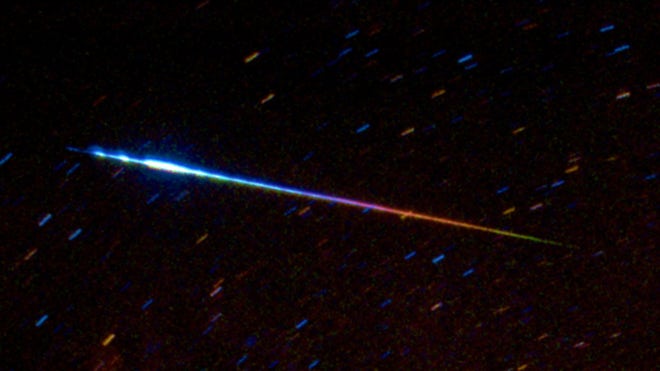
A Geminid meteor streaks across the sky. (Jimmy Westlake / NASA)

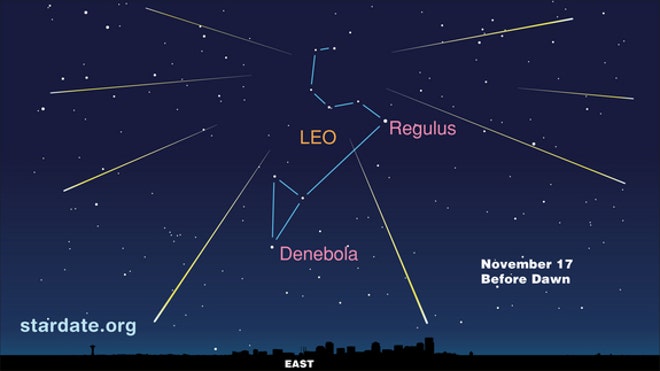
This sky map for the Leonid meteor shower of 2012 shows the location of the radiant (center) before dawn on Saturday, Nov. 17 - the peak viewing time. (StarDate.org)

This weekend brings us the return of the famous Leonid meteor shower, a meteor display that has brought great anticipation and excitement to night sky watchers around the world.

This will be a favorable year to look for the Leonid meteor shower because the moon will be only crescent and will have set in the west long before the constellation Leo begins to rise into the night sky. The Leonids appear to radiate out of Leo (hence their name), and with the moon out of the sky completely, viewing conditions could be perfect for stargazers with clear weather and dark skies.

The Leonid meteors are debris shed into space by the comet Tempel-Tuttle, which swings through the inner solar system at intervals of 33 years. With each visit the comet leaves behind a trail of dust in its wake. Much of the comet’s old dusty trails litter the mid-November part of Earth’s orbit and the Earth glides through this debris zone every year.

Occasionally, Earth passes directly through an unusually concentrated dust trail, or filament, which can spark a meteor storm resulting in thousands of meteors per hour. That’s what happened in 1999, 2001 and 2002. Since the Tempel-Tuttle comet passed the sun in 1998, it was in those years immediately following its passage that the Leonids put on their best show.

But now, the comet and its dense trails of dust have all receded far outside Earth's orbit and back into the outer regions of the solar system. So odds are that there is little, if any chance of any unusual meteor activity.

Peak times to see the Leonids
In the 2012 Observer’s Handbook of the Royal Astronomical Society of Canada, meteor experts Margaret Campbell-Brown and Peter Brown, indicate that this year’s peak activity should occur on Saturday morning, Nov. 17, at about 3 a.m. ET (0800 GMT). This is the moment when the Earth will be passing closest to the orbit of the long-departed comet, and when our planet seemingly is most likely to encounter some residual comet material. This time is highly favorable for North Americans, especially those in the eastern United States and eastern Canada. [Top 10 Leonid Meteor Shower Facts]
But while Leonid rates are unpredictable, it is unlikely that more than 10 to 20 meteors per hour may be seen this year.
Other meteor researchers, however, such as Jeremie Vaubaillon of France, and Mikhail Maslovof Russia have examined Leonid prospects for this year and also suggest watching for some meteor activity three days later, on Tuesday morning, Nov. 20.

For example: Sometime around 1 a.m. EST (0600 GMT), the Earth may interact with material that was shed by comet Tempel-Tuttle back in the year 1400. But at best, only about 15 to20 Leonids per hour may be seen.

Although the Earth will pass almost directly through the center of this supposed cloud of comet dust, the fact that it is situated far from the parent comet, plus gravitational perturbations affecting these particles after making 18 trips around the Sun, dictate that any meteor activity will be sparse at best. Eastern North America appears to be in the best position to see any possible Leonid activity.

Leonid meteor shower: How to watch
The meteor shower will appear to emanate from out of the so-called "Sickle" of Leo, but prospective viewers should not concentrate on that area of the sky around Leo, but rather keep their eyes moving around to different parts of the sky.
It is best to bundle up warmly again the chill of mid-November night and to lie down on a lawn chair wrapped inside a blanket or observe from the comfort of a sleeping bag. A thermos of a hot beverage such as coffee, tea or soup makes a good companion.

Because Leo does not start coming fully into view until the after midnight hours, that will be the best time to concentrate on looking for the Leonid meteors. The hours after midnight are generally best for watching for "shooting stars" anyway, because before midnight we are riding on the back side of the Earth in its orbit around the sun, whereas after midnight we are on the front or advancing side.

After midnight the only meteoroids escaping collision are those ahead of the Earth and moving in the same direction with velocities exceeding 18.5 miles per second. All others we will either overtake or meet head-on. But before midnight, when we are on the backside, the only meteoroids we encounter are those with velocities high enough to overtake the Earth. Therefore, on the average, morning meteors appear brighter and faster than those we see in the evening.

And because the Leonids are moving along in their orbit around the sun in a direction opposite to that of Earth, they slam into our atmosphere nearly head-on, resulting in the fastest meteor velocities possible: 45 miles per second. Such speeds tend to produce bright meteors, which leave long-lasting streaks or trains in their wake.
http://www.foxnews.com/science/2012/11/ ... -saturday/" onclick="window.open(this.href);return false;

UdornLA
Pies are for Fattys

Re: outdoor activities..Meteor Showers.

Post by UdornLA » Sat Nov 17, 2012 8:40 am

Image

UdornLA
Pies are for Fattys

Re: outdoor activities..Meteor Showers.

Post by UdornLA » Sat Nov 17, 2012 9:44 am

Image

http://en.wikipedia.org/wiki/Leonids" onclick="window.open(this.href);return false;

UdornLA
Pies are for Fattys

Re: outdoor activities..Meteor Showers.

Post by UdornLA » Sat Nov 17, 2012 11:51 am

extremely overcast down here also, with a spot of rain.......very small spots.........so may be sleeping in also tonight. should go on for couple days though. we're well away from city glare, so no need to go to phu foilum, though if nice, may take a drive over, as very close.

UdornLA
Pies are for Fattys

Re: outdoor activities..Meteor Showers.

Post by UdornLA » Wed Nov 21, 2012 4:59 am

very clear night, but i got viewing just before 4 am. saw a few faint and short ones. maybe a second, and think i'm getting some sunrise glare now.

on the good side, i think, and checking the internet, possibly say the ISS zipping by, very faint, but very distinct. will check that out tomorrow, and in the future as found a website that tracks it. actually pretty cool. it was coming in a SE direction, which i tilted chair to, as less glare, when i noticed it. not time to get binocs, but will have in future..... ++)(*

don't know how much more of the leonids will be left the next night or 2, or if sun glare is needed to see ISS. but that kind of crap interests me.

Image

ISS tracker, gives time and path.

http://www.isstracker.com/historical" onclick="window.open(this.href);return false;

Loki
Pies are for Fattys

Re: outdoor activities..Meteor Showers.

Post by Loki » Tue Apr 09, 2013 7:10 am

Image

Image
http://planetsave.com/2013/04/07/lyrid- ... l-22-2013/" onclick="window.open(this.href);return false;
Image
http://www.spacedex.com/lyrids/location ... ailand.php" onclick="window.open(this.href);return false;
Image

http://scienceheathen.com/2012/12/28/me ... ntids-etc/" onclick="window.open(this.href);return false;

http://en.wikipedia.org/wiki/Lyrids" onclick="window.open(this.href);return false;

Loki
Pies are for Fattys

Re: outdoor activities..Meteor Showers.

Post by Loki » Mon May 06, 2013 5:03 am

They didn't give much of a heads up for this one, and that would be now, and tomorrow, maybe some the following days. not exactly clear skies now.

Meteor shower created by Halley's Comet to peak Sunday
NASA will provide live video of the event, as well as a live chat with Bill Cooke, head of NASA's Meteoroid Environment Office.

by Steven Musil May 5, 2013 12:23 PM PDT
Image
The Eta Aquarid meteor shower.

The meteor shower created by the debris trail of Halley's Comet will peak Sunday evening, and NASA is providing a live view of the celestial fireworks show.

Prime viewing of the annual Eta Aquarid meteor shower should be around 9 p.m. ET, providing stargazers with 30 to 40 meteors an hour, according to NASA. A camera at NASA's Marshall Space Flight Center in Hunstsville, Ala., will provide live video of the event from 8 p.m. ET to 3 a.m. ET Monday (see below).

The space agency will also host a live chat with Bill Cooke, head of NASA's Meteoroid Environment Office at the center, who specializes in the meteoroid environment and its effects on space vehicles.

For those astronomy fans wishing to watch the show in person, NASA suggests finding a spot away from bright city or street lights. "Lie flat on your back on a blanket, lawn chair or sleeping bag and look up, taking in as much of the sky as possible," NASA said in a statement. "After about 30 minutes in the dark, your eyes will adapt and you will begin to see meteors. Be patient -- the show will last until dawn, so you have plenty of time to catch a glimpse."

The meteor shower, which is created when the Earth passes through a trail of space debris left over from Halley's Comet's 76-year orbit around the sun, gets its name from the constellation Aquarius, where the meteors appear to originate.

Loki
Pies are for Fattys

Re: outdoor activities..Meteor Showers.

Post by Loki » Sun Nov 17, 2013 1:46 pm

It's back, and actually a little late posting, but should still be quite decent.
Spectacular Leonid meteor shower to peak this weekend.......NOW

Image
Stars outnumber Leonid meteors lighting up the night sky of the desert near Amman

The Leonid meteor shower, one of the most dependable meteor displays of the year, will be at its most impressive overnight Saturday and early Sunday. For the best viewing, stargazers are advised to lie down on the ground, far away from artificial light.

The annual meteor shower occurs each November when the earth passes through a stream of space debris left in the wake of the Temple-Tuttle comet.

As the icy comet streaks towards the sun, it is slowly melting. It reaches the Solar System once every 33 years, leaving a rocky trail millions of miles wide and hundreds of miles long. As the earth moves through the comet’s orbital path, the debris burns up in the atmosphere, causing what looks like shooting starts to dance across the night sky.

Some of the rocky trail drifts into earth’s orbit every November. The debris collides with the earth’s atmosphere and the rocks are vaporized in a flash, giving the illusion of fireballs exploding out of the constellation Leo.

Although the meteor shower takes place on a smaller scale every year, it is truly breathtaking every 33 years, with more than 1,000 meteors lighting the sky every hour. This kind of display will not happen until 2034.

This year, the meteor shower will be partially obscured by the full moon.

“Unfortunately the full moon in the sky will likely wash out all but the very brightest Leonids. The shower should be visible from any populated area on the planet with clear dark skies, though Northern Hemisphere observers are favored due to the radiant’s location in the constellation Leo,” officials from NASA explained in a skywatching guide.

They added that for the best view, stargazers should lie on the ground and look straight up into the dark sky, away from artificial lights.

However, NASA is not able to predict the intensity of the display, as there is no way of knowing how much debris is in each stream.

In 1833, observers could see up to 100,000 meteors per hour, while in 1966 viewers watched 10-15 meteors light up the sky per second. The last meteor shower like this was in 2002.

The best time to view the shower is not during its peak. Rather, it will be best viewed on Friday night between midnight and dawn, or even as late as mid-week next week during the same time, according to Space.com.

westerby
Pies are for Fattys

Re: outdoor activities..Meteor Showers.

Post by westerby » Sun Nov 17, 2013 3:10 pm

Do you gawp at the stars alot, LA? I'm guessing you may have a telescope and if so, did you buy it in Udon?

Loki
Pies are for Fattys

Re: outdoor activities..Meteor Showers.

Post by Loki » Sun Nov 17, 2013 3:20 pm

yes, though no telescope here....now, ex's family destroyed it. was excellent and couldn't even fit half the moon in, the weakest lens. could see the ridges in the craters. extremely powerful with most powerful lens, though once pass the moon, nothing really to zoom in on, to be practical. a good pair of binocs will do a good job, wide to allow light in.

do enjoy just laying there, when no moon, as you'd be surprised how many meteors you see when a shower. full moons definitely put a damper on it. you can get a couple decent ones, full second or if lucky 2 second streak. quite a few 'zips' where you're not sure if it was or wasn't, but was, or you wouldn't be there.

you can see the ISS with no problem at all, slowly, that's relative, go across the sky.

left over activity from my LSD days, when you could really see a lot more......... :shock:

Post Reply